
打ちたてうどん だし屋 東香里本店
Uchitateudondashiya
3.14
Hirakata, Neyagawa
「Udon」
1,000-1,999円
--
Opening hours: Lunch 11:30-15:00 (14:30L.O.) Evening 17:00-22:00 (21:00L.O.) Open Sunday
Rest time: non-scheduled holiday
大阪府寝屋川市成田東町28-20
Photos
(20)







Details
Reservation Info
can be reserved
Children
Children and baby carriages allowed
Baby food OK
Payment Method
Credit cards accepted
(VISA, Master, JCB, AMEX, Diners)
Electronic money is not accepted.
Number of Seats
40 seats
Private Dining Rooms
Yes
(6 available, 8 available)
Smoking and Non-Smoking
No smoking at the table
Parking
having
Facilities
Calm space, tatami room, sunken kotatsu
Dishes
Focusing on vegetable dishes, health and beauty menu available
Comments
(20)

3e4ab475205
4.50
【Highly recommended!】I visited the restaurant looking forward to the smooth, freshly made noodles as mentioned in the reviews! The noodles were indeed smooth and chewy, and incredibly delicious! The broth, just like the name of the shop suggests, was outstanding! The tempura bowl was also very generous in portion size. It took a bit of time for the food to be served, so I deducted 0.5 points for that.


グルメおばけ
3.00
This week's lunch special, Set A with mentaiko rice, was disappointing. The mentaiko had a strange color that reminded me of unhealthy American snacks. It was a stark contrast to the high-quality ingredients like Ran-oh eggs and delicious broth used in other dishes. I hesitated to eat it and will not be ordering mentaiko again. However, the chicken curry udon was delicious and satisfying.


グルメおばけ
3.00
I tried the white hot pot with beef tripe when I first visited, but today I decided to go with the classic red hot pot. I also had the Orchid King's egg over rice. I like spicy food, but I felt the white hot pot had more umami flavor, so I added some shichimi spice to it and it was delicious. It was a weekday, but they didn't have a weekday lunch special, which was a bit disappointing. Also, it was strange that some menu items listed on Tabelog were not available in the restaurant.


グルメおばけ
3.00
On my visit, I was drawn to the cold noodles, but I also craved hot curry udon on a hot day. This restaurant also serves motsunabe (tripe hot pot) at night. Motsu lovers should try the hot motsu curry udon. It had tender motsu in curry with a flavorful broth. Satisfied!

しょー36394
4.00
I visited the restaurant on Saturday afternoon. I ordered dashimaki tamago, Maru Toki udon, and Ooyama toriten udon. The toriten had a crispy exterior and juicy interior, very delicious. It tasted even better when dipped in the broth. The udon noodles were not too firm and slightly thick. I tried the warm udon and the broth was delicious. The service was a bit cold.


5e579a
3.40
I have been curious about this izakaya for a while, so I decided to have lunch there. I ordered the beef and grated yam bowl with a side of mini udon. I shared it with my 1-year-old daughter. The beef and grated yam bowl had well-seasoned and tender beef, and the grated yam was sticky and delicious, making the rice very appetizing. The udon had a tasty broth, and my daughter almost finished the mini udon. She is usually very picky, so it was rare to see her eat this much. Both dishes were very delicious.


酒馬
3.50
I want to go again if I have the chance to go nearby, and when I feel like eating udon, this place is a contender. Next time I go, I want to try either the traditional udon or curry udon. I ordered the limited 3 types of meat udon. The broth in the meat udon was a bit on the sweeter side, maybe because it's meat broth. Due to the sweetness, I honestly felt that the broth was a bit heavy. The udon noodles were slightly firm, not the slippery smooth type. Perhaps because of the rich toppings and broth, the wheat flavor was not very noticeable. Overall, I felt that the cost performance was on the higher side. The atmosphere seems to cater more towards middle-aged and older customers. It has a calm ambiance.


ついてるちゃん
3.50
I visited the restaurant for lunch with a friend. My friend ordered warm udon noodles with lotus root tempura, while I ordered cold udon noodles with plum sauce. My friend had mentioned before that the lotus root tempura was unique and interesting, so I asked if it would be possible to add lotus root tempura (not on the menu) as a topping for the udon noodles, and they kindly agreed. The chef explained the unique way the lotus root chips were cut. The udon noodles were chewy, just the way I like them, and the broth for the cold noodles was flavorful. The restaurant was empty when we arrived, but by the time we left, it was full. The staff were friendly, and the manager was humble and kind. I apologize for asking for something not on the menu. Thank you for the meal.


さすらい講師
0.00
This spring, we had the "2021 Udon 20 Match" and now we have a new udon series. After this, we plan to have a "Ramen 20 Match Season 6". In the Udon 10 Match Part 4, we visited "Uchitate Udon Dashiya" in Neyagawa City, Osaka. Their Bukkake Udon costs 550 yen (excluding tax) and you can add toppings like Tai Chikuwa Tempura for 250 yen (excluding tax). They also offer free extra noodles.


とおる王子
3.50
Today's lunch was at a place halfway between Neyagawa City, Kouri-en Station, and Katsuragi Station. I had freshly made udon at Dashiya. The large shrimp tempura udon cost 957 yen, while the shrimp and vegetable tempura zaru udon also cost 957 yen. I also ordered mixed rice for 165 yen and a half-cooked egg tempura for 165 yen. The noodles were especially delicious when dipped in warm broth. I'm glad I got the large serving of zaru udon with 1.5 portions. The shrimp was big and tasty, and the tempura batter was thick and firm. The mixed rice had a strong flavor. As expected, freshly made udon is always good. Osaka gourmet, Osaka lunch.


まさもん
3.30
I went to have lunch at a restaurant I had been wanting to visit. It seems like the shop's specialty is the carefully prepared dashi broth. Since it was a hot day, I decided to try the cold bukkake udon with grated yam, raw egg yolk, and mixed rice. The udon arrived, and it was firm and chewy, with a good texture. The grated yam topping was delicious and rich. The raw egg yolk was from a special type of egg called Ran-oh, which had a vibrant orange color and a rich taste. The combination of the grated yam and Ran-oh egg yolk was fantastic. The mixed rice was lightly seasoned. I ordered a regular portion of udon, which turned out to be just the right amount, especially with the mixed rice. Overall, I recommend trying the bukkake udon with grated yam and egg yolk topping, as it was delicious.


Jiu3116
3.60
On Sundays at noon, my wife and I go out for lunch. Today, we decided to try the newly opened udon restaurant in the neighborhood. When we arrived around 12 o'clock, the interior of the restaurant had a simple and calming atmosphere with black as the base color. There were tables for two and three for four people, as well as tatami seating. The place seemed quite popular with four groups of customers already there.
I ordered the "bukkake udon" (550 yen) with a topping of "half-cooked egg tempura" (130 yen) and "mixed vegetable rice" (150 yen). My wife chose the "bukkake udon" cold style with a topping of "vegetable tempura" (280 yen). The udon here is cooked to order, so it took about 15 minutes for our dishes to arrive.
The udon was presented beautifully with white noodles topped with kaiware radish, green onions, and a slice of lemon. After squeezing the lemon and pouring the broth over the noodles, I took my first bite. The noodles were firm with a good chew, similar to Sanuki udon. The broth had a gentle flavor, although I personally prefer a stronger taste. Nonetheless, it was delicious.
The owner, who originally worked in Japanese cuisine, clearly knows how to make a good broth. The mixed vegetable rice complemented the udon well and was just the right portion size. After finishing our meal, we were both satisfied and happy with the delicious udon experience. My wife mentioned that it was a nice change from the usual and she enjoyed the different flavor of the broth compared to Sanuki udon. Overall, it was a satisfying meal. Thank you for the feast.



sra00
3.80
We ordered the specialty dish called Lotus Root An Sauce Udon, my wife ordered that, my mother-in-law ordered the classic Kitsune Udon, and I ordered the Kitsune Udon lunch set. The Lotus Root An Sauce Udon had thinly sliced lotus root fried on top, with a ginger-flavored broth that warmed us up and tasted delicious. The Kitsune Udon had a traditional flavor, but the noodles were not as chewy as authentic Sanuki Udon, so it's best to think of it as a different type of udon.


寝屋ログ太郎
3.70
Many people have started work today (1/5, Tuesday) at 12:25. The parking lot in front of the store is completely empty. Inside the store, I can see three groups of people. There seem to be more seats in the back. The interior of the store is sleek with a black theme. However, the staff are dressed in regular diner-style uniforms, which is quite amusing.
I ordered the Lotus Root Oroshi Udon for ¥980, an extra 1.5 servings of udon for ¥60, and a lunch set with salmon rice for ¥150. The Lotus Root Oroshi Udon is a specialty dish here. I was looking forward to it, and when it arrived, I was surprised by the large bowl it came in. The noodles were slightly flat and had a good texture. The broth was a bit salty, but elegant, and the grated lotus root added a nice, slightly thick touch to it. The salmon rice, however, was unnecessary in my opinion. The soup for the udon was a bit light on salt, so I added a little from the tableside shaker.
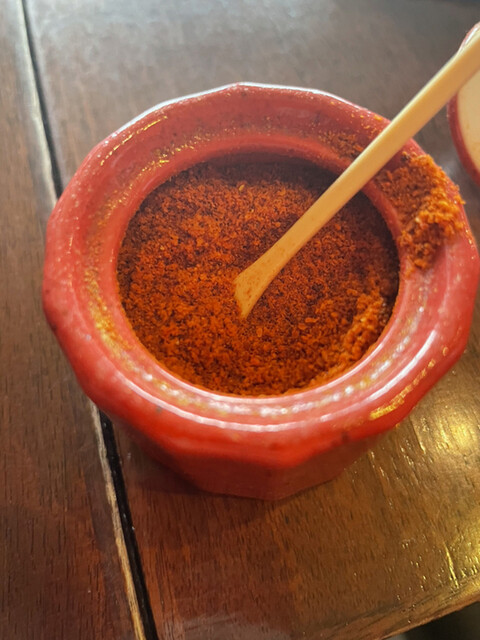
Overall, the udon was delicious, but the price is a bit high, making it hard to evaluate. The chili powder provided was quite spicy, which I personally enjoyed. In the nearby area of Kouri-en, there are other well-known udon restaurants like "Oriented towards the circle" and "Kame Seimen," so despite the delicious udon, it might be a bit challenging as a business. Taking all these aspects into consideration, I would say the cost performance is a bit tricky.


ロストフの14秒
3.00
I had the warm "Shrimp and Vegetable Tempura Udon (tax included 1,070 yen)". It was quite a good price. It was the first time I had ordered udon alone for over 1,000 yen. The shop was called "Dashiya", so I had high expectations for the udon broth. When I tried it, it was a rich Osaka-style broth with a slight sweetness. While the quality was good and the flavor was nice, it was not to my taste as it was a bit too strong for me. I prefer a lighter flavor. It was similar to the broth at "Udon Kuraten" in Senri-Oomiya or "Udon Sakaba Hachiman Morinomiya" in Morinomiya, both in Osaka. However, I think there are people who would really enjoy this broth. The udon noodles were medium-thick and on the firm side. Although there was no description of "Sanuki Udon" anywhere in the shop, it can be assumed to be of that style. In Sanuki, there are often udon noodles like this, which are firm (not as chewy). I enjoyed the slurping sensation and the slight bounce when chewing, which I like. However, the wheat aroma and flavor of the udon noodles were a bit weak. I expected a better flavor from the udon noodles themselves, especially if they are of the Sanuki style. The tempura consisted of shrimp, eggplant, pumpkin, and shiso leaf. The tempura, served separately from the udon, had a very thin batter to enhance the flavor of the ingredients. It was clearly traditional Japanese tempura. I personally feel that this type of delicate tempura does not pair well with tempura udon. Most people who order tempura udon would not want to eat the udon and tempura separately. The appeal of tempura udon is when the tempura batter absorbs the broth's flavor and becomes deliciously soft. The combination of the batter and the broth creates a synergistic effect. Placing delicate, authentic Japanese tempura on top of udon does not achieve the same result. In this case, I had the tempura placed on top of the udon. While I could taste the flavors of the tempura ingredients, it felt somewhat lacking. Additionally, in terms of portion size, adding 60 yen allows for 1.5 servings, and adding 100 yen allows for 2 servings (if I remember correctly, apologies if I am mistaken). The udon noodles were firm and filling, so for an average adult male, one serving is sufficient. Ordering 1.5 servings or more is likely only for those with a big appetite. I had the udon around 1 pm, and I did not feel hungry until around 9 pm. It was very filling. However, even taking a positive view, I still think 1,070 yen including tax is a bit expensive. The shop is located along a road in a residential area, not near a station. I know a udon shop I often visit where the tempura udon is 750 yen including tax, with a natural broth and hand-made udon noodles. The shop is known locally for the delicious broth. The tempura may not be freshly fried, but it is delicious in its own way. Knowing such a shop, I, as someone who values cost performance, have to give a slightly lower rating. **Additional Note** When I walked from Keihan Katsuragawa Station to the shop, the sidewalk along the road was extremely narrow! Most of it felt more like a shoulder than a sidewalk. Moreover, the road was winding and there was a lot of traffic, making it very dangerous. If you plan to visit this shop from Katsuragawa Station, I recommend taking a bus instead.



ZEX
3.90
I went to this newly opened udon restaurant and checked out their website. The owner, who has a background in Japanese cuisine, seems to be particular about the broth. The noodles are freshly made and boiled just before serving, so it seems like you can enjoy a proper meal here. I was interested in their specialty lotus root grated udon, but since I prefer bukkake style, I ordered the tempura vegetable bukkake udon with chicken tempura generously included. It's a bit unusual to see the tempura served in this way. On top of the udon, there's grated daikon radish, and next to it, there's something red... I thought it might be pickled ginger, but it wasn't spicy at all, so I couldn't figure out what it was until the end. Anyway, I poured the broth over, squeezed some lemon, and started eating. The udon had a nice firm texture, especially since it's cold, and udon with a strong chew is always satisfying. The broth was packed with the flavors of bonito and dried sardines, very delicious. Tempura soaked in this broth is really tasty, isn't it? This kind of dish is perfect for hot weather! Surprisingly, it was a udon restaurant of a high standard. I'd like to try their specialty lotus root grated udon next time. By the way, it seems that they only accept cash payments.


chirolian61
3.30
Today, I visited a newly opened udon restaurant in Higashi-Kouri, Neyagawa. I arrived before 1 o'clock and there were 3 groups of customers ahead of me and 2 groups behind me. The interior of the restaurant had a calm atmosphere with a black color scheme, a kitchen that couldn't be seen in the back, no counter seats, 2-4 person tables on the right, and a raised tatami area with 2 tables on the left. The restaurant was run by 3 staff members, two men and one woman. The menu included several types of hot and cold udon, toppings, rice dishes, and two daily sets. I ordered the "Beef Curry Udon & White Rice" which arrived in a large bowl. The udon noodles were clear and flat with a soft and chewy texture, and they had a good mix with the curry powder-based broth that had a strong thickness. Inside the bowl, there were beef, chopped fried tofu, onions, and green onions. The rice was also good, and I finished it along with the pickled seaweed and cucumber. It was a bit disappointing that there wasn't as much meat as the name suggested, so I hope they can lower the price to under 1000 yen for this dish. Despite opening during a difficult time, I wish them the best of luck. The service was good. Thank you for the meal. Additional notes: Prices do not include tax, no wheelchair accessibility, washlet available in the back on the left side, and there are a few parking spaces in front of the restaurant.


yuki-354
3.00
A family of four (2 adults, 2 children) visited the restaurant. We ordered the lunch set which included black motsu udon (soy sauce flavor), katsudon set with udon, and miso katsudon set with udon. We dined in a private room, but it was hot inside and we couldn't adjust the air conditioning. Eating hot udon in the sweaty room was a bit tough. The black motsu udon was delicious, but we opted to exclude garlic since it was lunchtime. The katsudon and miso katsudon had decent portions, but the taste was average. It felt like there was less katsu compared to the rice. The miso in the miso katsudon was more salty than sweet, which was not to my liking. I would like to try this restaurant again in winter.
グルメおばけ
3.00
This week's lunch special B is a bowl of tempura with cherry shrimp and seasonal vegetables, along with Kitsune Udon. It was my first time trying a simple, warm udon. I poured the udon broth over the leftover bowl at the end to make a tempura-dipping tea. I wonder what I should order tomorrow.


うさこ0110ima
4.50
I have used this restaurant many times. The inside of the restaurant has a nice aroma of good soup stock, so my expectations are high even before eating. This time, I ordered shrimp and vegetable tempura udon. The soup stock was delicious, and the udon noodles had a good chewy texture that was easy to eat. The tempura was served separately, so I could enjoy the crispy texture until the end. It's a favorite restaurant where I want to come back again!


Email Login